News Content
Cet article n'est disponible qu'en anglais.
Ten years ago, the Paris Agreement was signed with the aim of limiting global temperature rise. The world recognised the urgent need to improve resilience to climate change and reduce carbon emissions.
Ten years on, our progress at Unibail-Rodamco-Westfield shows that our people-centred approach to achieving net zero emissions has made sustainability deeply and durably embedded in the company's DNA and business activities.
Thanks to the dedication and unrivalled expertise of our teams across all levels of our organisation, we have made great progress across the 3 pillars of our Better Places sustainability roadmap, set in the context of the 2015 Paris Agreement and accelerated in 2023: Environmental Transition, Sustainable Experience and Thriving Communities.
On the 10th anniversary of the Paris Agreement in 2025, we are proud to share that we continue to meet our ambitious Better Places targets, and highlight our achievements in terms of carbon emissions reduction, energy efficiency, and environmental performance.
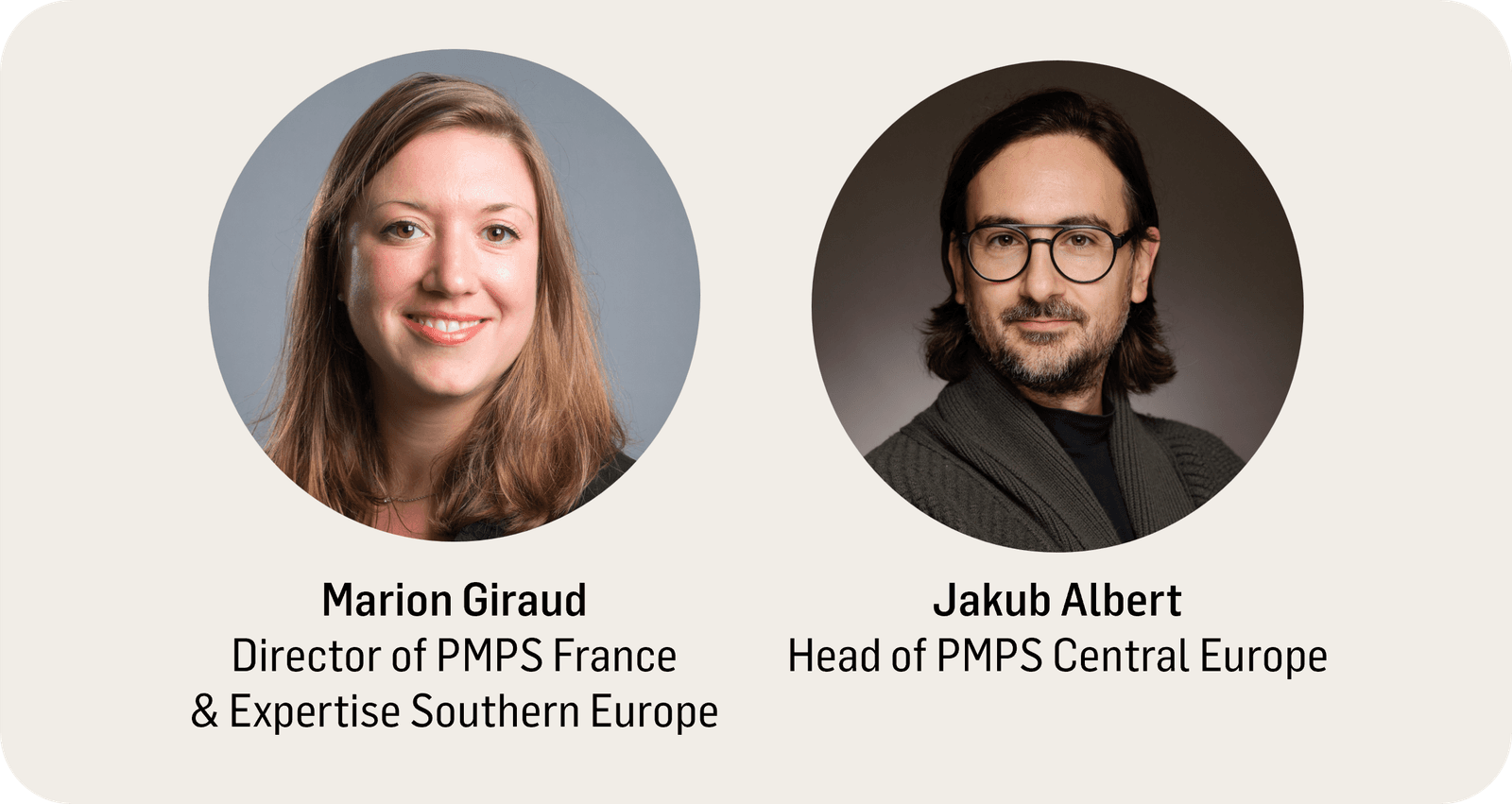
For the occasion, we invite you to go behind the scenes with Marion Giraud, Director, PMPS France and Expertise Southern Europe, and Jakub Albert, Head of PMPS, Central Europe as they share how they are driving progress on the Better Places sustainability roadmap.
Hear from Marion Giraud and Jakub Albert on how they are delivering on our Better Places targets
How does the Better Places commitment translate into your and your team's day-to-day work?
Marion Giraud: We haven't invented new plans; we've fundamentally reset our ways of thinking and working to make our maintenance operation fit with our Better Places objectives. Now, we align our investment and operating plans for each of our shopping centres with a constant attention to manage OPEX and CAPEX in compliance with URW's core commitments toward decarbonisation and energy efficiency. We work with each local team to challenge, and proof track their plans, aligning objectives around waste, water, energy, and safety. Ten years ago, we were focused on the basics. Now, we've progressed towards our 2030 target by nurturing stronger sustainability-driven habits and reaching energy reduction through energy sobriety. The goal isn't to invest more money, but to invest smarter, and to reduce at the end the charges with more efficient equipment.
Jakub Albert: In 2016, shortly after I arrived, URW announced its commitment toward the reduction of GHG emissions. The Better Places plan provided a clear pathway for all teams to follow, and embedded sustainability into the core of everything we do. For my team, our role is to interpret the top-level targets that were set for the whole Group and work alongside the centre teams to achieve them. It means we are constantly reviewing each building individually and coming up with concrete projects to reduce energy consumption and emissions. And the shopping centre teams are really eager to find agile solutions and drive this strategy forward in their own buildings.
Beyond the visible metrics and installations, tell us about the invisible work that goes into making Better Places and the environmental transition happen?
Marion: The most important aspect is the amount of time and effort we spend engaging with all URW teams. We can't easily or exactly measure the hours spent training our teams and raising awareness against the targets we want to achieve. We also keep our tenants at the core of our action. We have implemented a tracking system to ensure compliance in waste and energy management. The challenge is big, and the devil is in the detail: for example, take a ham packaging, if plastic and packaging are not properly separated, it compromises the recycling stream. Driving this behavioural shift is fundamental to progress towards our targets.
Jakub: The invisible part is dealing with existing buildings, which all have their specificities. There’s no one-size-fits-all solution. Our buildings vary in size and age, so we review them individually to identify opportunities to improve energy efficiency or reduce CO2 emissions. Solutions include replacing outdated equipment – for example, we are planning on replacing gas heating with heat pumps at our assets in Prague, a significant step toward decarbonisation. But the crucial work is having a long-term view, developing a long-term energy plan for each asset. You need a good overview of all your projects and how they fit together over time. It's an iterative process where you meet with the local team a number of times in a year, you review options, you redo your plan. There’s a lot of behind-the-scenes work that happens long before a solar panel (PV) is installed.
What is the one project or innovation you feel most proud of?
Marion: All the energy sobriety measures focus on human, behavioural change. Seeing the collective mobilisation of our teams is incredibly rewarding, and this tangible cultural shift makes me proud! It validates the effort invested in training and in developing innovative approaches to tackle the challenges we face. In Southern Europe, we've achieved a 25% energy reduction through sobriety alone, which signals deep-rooted sustainable practices. We’re deploying Building Management Systems that automatically control lighting and ventilation. We are installing submeters to measure where and when energy is consumed. And we’re pilot-testing, today manually, tomorrow with AI, with AI at Westfield Euralille to adjust energy consumption in specific zones depending on occupancy and people's outfit. Our teams and business counterparts are now ready and convinced that we must take action. We will in the years to come take concrete steps and launch the necessary operations, implement geothermal energy, and help decarbonise city centres.
Jakub: I’m proud of the fact that Better Places is not just a slide in a presentation. It empowered us to turn intent into action through meaningful investment. If you look on Google Maps, you’ll see our roofs are covered with solar panels. We have a long history of innovation in Austria, where we pioneered the installation of photovoltaic panels on centre roofs. Today, we're pushing the approach to the next level, leveraging every opportunity. We replaced a glass roof while integrating PV panels, delivering both shade and renewable energy. We implemented PV canopies in parking areas – it’s a win-win: shielding cars from direct sunlight and enhancing the customer experience, while generating clean electricity for the centre. And where we don’t have much space on roofs, we use light PV panels, a plastic mat that you stick to a light roof or façade. Creativity is limitless! In some centres, the solar energy we produce can cover up to 30% of our consumption.
What were the key challenges in getting everyone aligned and equipped?
Marion: The main challenge both then and now, is education and changing mindsets. Our centres have ultra-demanding objectives for image, service, and marketing. And this teamwork is essential. Practically, our approach is two steps: first, having the centres draft their own transformation plans. Then, my expertise team evaluates and challenges these plans to ensure they are aligned with our global objectives and are the best technical solution, as efficient as possible. Our on-site technical managers play a key part in driving energy efficiency initiatives and managing budgets efficiently. They identify needs and draft their transformation plans for the centres. We mobilise the centres’ teams, and increasingly, the most engaged centres come to us with their own ideas.
Jakub: We work in the exact same way in Central Europe. My role is to share proven knowledge and technologies, tested in other centres, that can be successfully applied elsewhere. My team constantly acts as a bridge, interpreting group targets, challenging local teams (our most frequent question: “What else can we do?”), and sharing technologies and learnings. It’s a dialogue, not an injunction. The local teams have the essential knowledge of their own buildings, visitors and local communities, and are the ones implementing Better Places, so our role is to push, support, and ensure the long-term plan for each centre makes both environmental and financial sense. All in all, this sustainability mindset has become a natural part of the technical and centre management teams’ day-to-day work. We’re driven to enhance the energy performance of our buildings, to improve their CO2 footprint. Our sustainability achievements are among the strongest factors of engagement and a source of pride for my teams.
Go further and read more about Better Places
Energy sufficiency and decarbonisation across our portfolio
URW is actively decarbonising its portfolio through targeted, innovative projects that reduce carbon emissions. We are maximising on-site renewable energy by integrating solar solutions into our assets. From solar panels in glass roofs and parking canopies to lightweight solar mats, this smart use of space aligns solar generation with our energy needs, covering up to 30% of a centre's consumption1. URW is also a catalyst for accelerating low-carbon mobility. We have delivered a large EV (electric vehicle) charging hub, with more than one thousand charging points in use across our assets in Europe.
Key results:
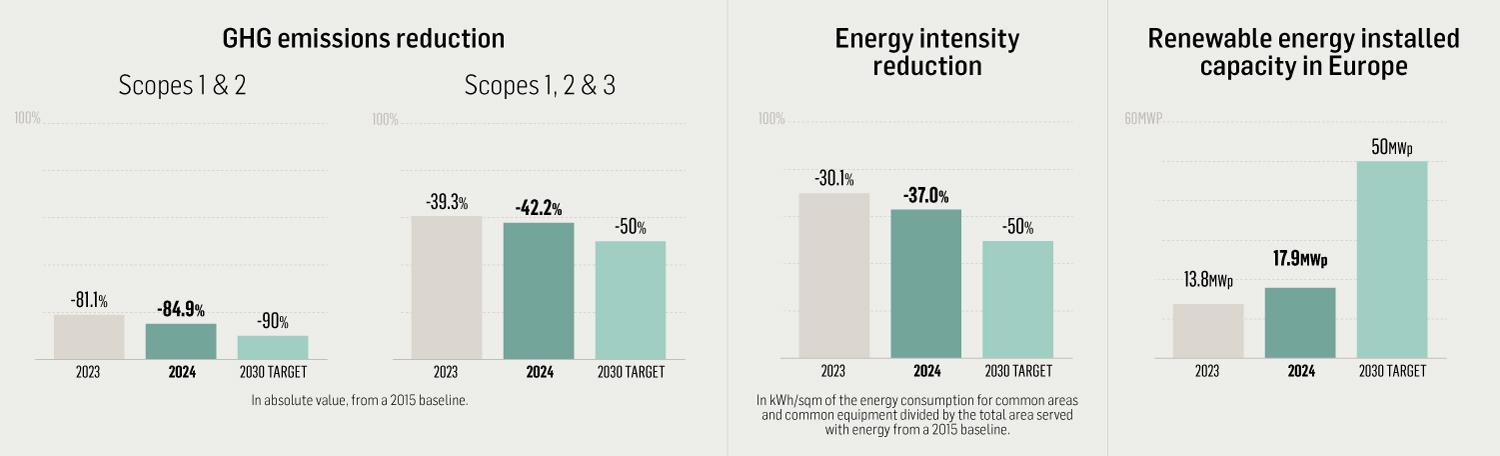
-84.9% reduction in carbon emissions on Scopes 1 & 22 (from -81.1% in 2023) on track with our -90% target by 2030
-42.2% reduction in carbon emissions from Scopes 1, 2 & 33 (from -39.3%4 in 2023) vs. -50% target by 2030
17.9 MWp renewable energy installed capacity in Europe (up from 13.8 MWp in 2023) vs. our target of 50 MWp by 2030 in Europe
4,000+ EV charger plan in Europe, of which 1,1574 were in use in 2024.
Globally, 48.0% of our visitors accessed our destinations by sustainable transport in 2024 (up from 47% in 2023).
Energy sobriety, waste, water: awareness and engagement
URW keeps its employees and tenants at the core of sustainability actions. Sustainability training, sessions with experts, and awareness campaigns are building blocks in our people-centred approach, ensuring URW is on track to reach its targets of zero waste, recycling and water consumption reduction, as well as energy intensity reduction. Our commitments around energy sobriety are backed by technological innovation. Initiatives to support this important behavioural shift include tracking systems to ensure compliance in waste management, submeters to measure where and when energy is consumed, and Building Management Systems (BMS) to efficiently control energy consumption and reduce energy waste.
Key results:
-37.0% reduction in energy intensity5 (from -30.1% in 2023) vs. -50% target by 2030
47.2% recycling rate6 (up from 44.4% in 2023) vs. 70% target by 2030
Water consumption reduced to -15% per footfall7 (from -12.6% in 2023) vs. -20% target by 2030

Did you know?
URW’s contribution to Global Biodiversity Framework goals: Sustainable actions beyond decarbonisation
For the past few months, URW has been collaborating with the Science Based Targets Network (SBTN) to define science-based targets for nature—demonstrating our commitment to go beyond decarbonization and actively contribute to biodiversity and ecosystem preservation.
(1) Production-consumption may vary depending on factors including season (winter vs. summer) and angle of sun rays.
(2) In absolute value, from a 2015 baseline.
(3) In absolute value, from a 2015 baseline
(4) Corrected figure post 2024 audit.
(5) In kWh/sqm of the energy consumption for common areas and common equipment divided by the total area served with energy from a 2015 baseline
(6) From a 2019 reference, including waste from common and private areas of the shopping centres, Like-for-Like.
(7) In L/visit from a 2019 baseline.
